What Age is Considered Elderly? A Complete Guide for NRI Families (2026)
 Indiarootsuniversal@gmail.com
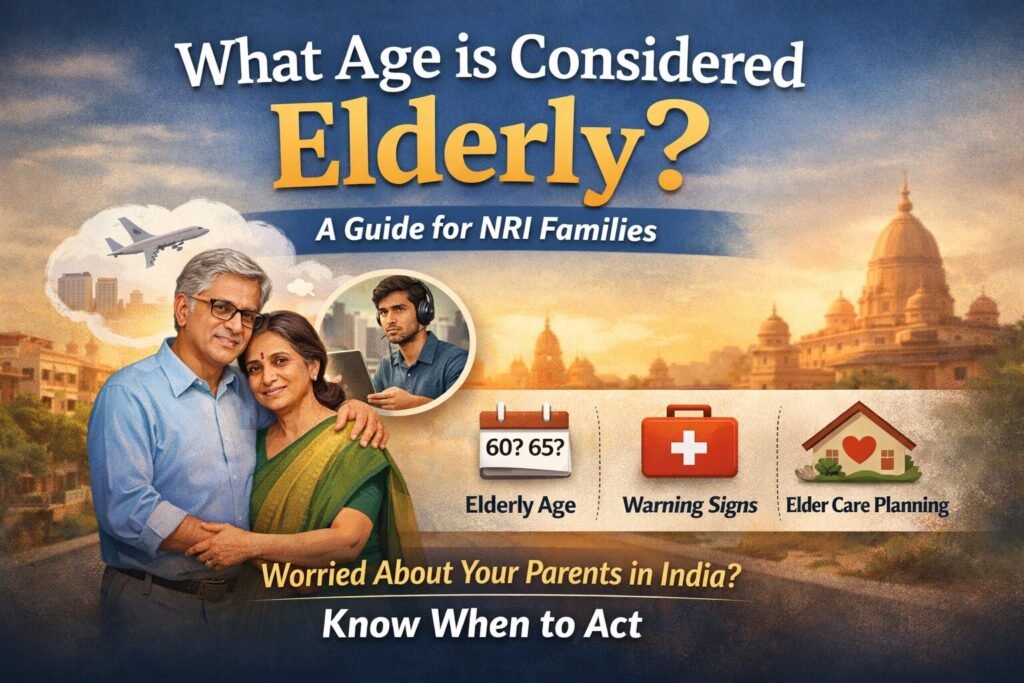
You’re thousands of miles away — managing work, family, and life in a different time zone — and suddenly a thought hits you: Are my parents elderly now? Do they need help?
It’s a question millions of NRIs silently carry. And the confusion is real. Is it 60? Is it 65? Is it when health starts to decline — or when a crisis actually happens?
This guide explains what age is considered elderly in India and globally, how to identify when your parents actually need support, and what NRI families should do next.
What Age is Considered Elderly?
| Context | Age Threshold |
|---|---|
| WHO (Global Standard) | 60+ |
| USA & Western Europe | 65+ |
| India (Legal Definition) | 60+ |
| Japan (Active Ageing) | 65–70 |
| Practical Reality | Depends on health, not age |
A person is considered elderly when they cross 60–65 years or begin to lose independence in daily life — not simply when they reach a specific number on a calendar.
This distinction matters more than any number. Keep reading to understand why — and what it means for your parents right now.
What Age is Considered Elderly Globally?
There’s no single universal answer — and that’s part of what makes this so confusing.
The World Health Organization (WHO) defines elderly as anyone aged 60 and above. These definitions are used by governments, healthcare systems, and insurance frameworks worldwide — making 60 the most widely recognised international benchmark.
In the United States and most of Western Europe, the threshold is typically set at 65, largely tied to retirement age and social security eligibility.
Japan — one of the world’s most rapidly ageing societies — places the marker between 65 and 70, reflecting a broader cultural shift toward what’s now called “active ageing.” Many 65-year-old Japanese adults are still working, travelling, and living fully independently.
Here’s the insight most sources miss: life expectancy worldwide is rising. A 65-year-old today is biologically younger than a 65-year-old two decades ago. This means the definition of “elderly” is quietly shifting later — and a fixed number tells you less and less each year.
What Is the Elderly Age in India? The Legal and Practical Reality
When asking what age is considered elderly in India, the legal answer is straightforward:
- Senior Citizen: 60 years and above (Income Tax Act, Senior Citizens’ Welfare Act)
- Super Senior Citizen: 80 years and above (for enhanced tax benefits)
But the practical reality is more nuanced. Here’s a framework that better reflects how ageing actually unfolds in Indian families:
| Category | Age Range | What It Means |
|---|---|---|
| Pre-Senior | 50–59 | Planning stage — health habits, finances, and support systems |
| Senior Citizen | 60–79 | Ranges from fully independent to semi-dependent lifestyle |
| Super Senior | 80+ | Higher likelihood of care needs and increased health risks |
The senior citizen age in India gives you a legal starting point. But your parents’ actual situation may look very different from these categories — which is exactly why age alone is never the full picture.
The Truth: Elderly Is Not About Age
This is the most important thing you’ll read in this guide.
There are two ways to measure age:
Chronological Age — the number on a birth certificate.
Functional Age (Care Age) — how well someone is actually managing their health, daily life, and independence.
Consider two real scenarios:
A 62-year-old with poorly managed diabetes, early-stage kidney disease, and no one nearby to check in — this person may genuinely need active support today.
A 75-year-old who walks daily, cooks her own meals, manages her own medications, and video calls her grandchildren every evening — this person may need very little intervention at all.
Same chronological age range. Completely different care needs.
We call this the “Care Age vs. Calendar Age” distinction. Your parents’ Care Age is what should actually drive your decisions — not the number on their Aadhaar card.
The most dangerous mistake NRI families make when thinking about elder care for their parents is waiting until a birthday milestone to act. By then, the window for preventive support has already closed.
7 Clear Signs Your Parents Are Entering the ‘Elderly Care Zone’
Forget the age number. The real question is not when are parents considered elderly — it’s when do they actually need support. Watch for these signs instead.
1. Frequent Hospital Visits Multiple hospital trips in a year — even for “minor” things — signal that health is becoming harder to manage independently. Each visit is a data point you shouldn’t ignore.
2. Forgetting Medication Skipping doses, mixing up medicines, or stopping prescriptions without telling the doctor. Medication mismanagement is one of the leading causes of preventable health crises in elderly Indians.
3. Reduced Mobility Slower walking pace, reluctance to climb stairs, avoiding outings they used to enjoy. Reduced mobility affects everything from nutrition to mental health.
4. Difficulty Managing the Home Unpaid bills, a cluttered or dirty home, uncooked meals, or neglected repairs. When the home starts to slip, daily life is already becoming overwhelming.
5. Social Withdrawal Pulling back from neighbours, friends, religious gatherings, or community events. Social isolation in elderly adults accelerates both cognitive and physical decline faster than most people realise.
6. Poor Nutrition Skipping meals, dramatic weight loss or gain, or surviving on tea and biscuits. In many Indian households, an elderly parent living alone will simply “not bother” cooking a proper meal.
7. Emergency Situations Without Support A fall, a sudden illness, a power cut, a medical scare — and no one nearby to respond. If your parents have faced even one such situation alone, that is a serious warning signal.
Quick Checklist — Check Your Parents Today:
- ✔ No hospitalisation in the last 6 months
- ✔ Medications taken correctly and consistently
- ✔ Moving around the home without difficulty
- ✔ Managing household tasks independently
- ✔ Socially active and connected
- ✔ Eating regular, balanced meals
- ✔ Has at least one trusted person nearby in case of emergency
If you checked no on even two of these, it’s time to act.
Why This Matters More for NRIs
Here’s the reality that no generic article on elder care for NRI parents will tell you: being an NRI fundamentally changes the risk equation.
When you live abroad, the gap between “something is wrong” and “you find out something is wrong” can be days, weeks, or longer. Parents — especially Indian parents — are conditioned to protect their children from worry. They won’t call you about a fall. They won’t mention they’ve been skipping meals. They won’t tell you the doctor raised a concern.
By the time you know, the situation has often already escalated.
There’s also the emotional weight that comes with distance: the guilt of not being there, the helplessness of not being able to respond quickly, and the constant background anxiety that shapes life abroad for so many NRI families.
Distance doesn’t delay ageing — it only delays awareness.
Delayed awareness means delayed intervention. And in eldercare, delayed intervention almost always means worse outcomes — more expensive, more complicated, and harder to reverse.
When Should You Start Planning Elder Care?
The honest answer: much earlier than you think.
Most families only start thinking about elder care for their NRI parents after a crisis — a fall, a hospitalisation, a sudden cognitive decline. At that point, you’re reacting under pressure, with limited options and high stress.
The better approach is to plan in stages:
Stage 1 — Preventive Care (Ages 50–60) This is the most underutilised window. While your parents are still healthy and independent, this is the time to have honest conversations, understand their preferences, review their health, and put basic support structures in place. Prevention is always cheaper — financially and emotionally — than crisis management.
Stage 2 — Monitoring (Ages 60–70) Regular health check-ups, awareness of emerging limitations, light support for household management, and a clear emergency contact plan. The goal here is to catch early signs before they become serious problems.
Stage 3 — Active Care (Ages 70+) More structured, hands-on support — whether from family, professional services, or both. This is also the stage where decisions about living arrangements, daily assistance, and medical coordination become most pressing.
The NRI families who navigate this best are those who treated Stage 1 as seriously as Stage 3.
Elderly Care Options in India
When the time comes, these are the main care models available for elderly parents in India:
Family-Based Care The traditional approach — a son, daughter, or daughter-in-law takes on the primary caregiving role. Deeply valued in Indian culture and often the preferred option for older parents. However, it can create significant stress on the family member providing care, especially if they have their own work and family responsibilities.
Local Helpers and Domestic Staff A cook, housekeeper, or part-time helper who can assist with daily tasks. Common in urban India and relatively affordable. Works well as a support layer but not as a comprehensive care solution.
Professional Elder Care Services Organisations that provide trained, managed support — covering everything from daily wellness checks to emergency coordination, medical assistance, and errands. This is the model that fills the gap for NRI families who cannot be present.
Assisted Living Facilities Residential communities designed specifically for elderly adults, with shared amenities, medical staff, and social programming. Growing rapidly in Indian metros. Best suited for those who need round-the-clock oversight or who are no longer comfortable living alone.
Quick Comparison: Elder Care Options in India
| Option | Best For | Limitation |
|---|---|---|
| Family Care | Emotional comfort and trust | Not practical for NRIs; risk of caregiver burnout |
| Local Helpers | Daily chores and household tasks | No medical expertise or accountability |
| Professional Services | Full support, monitoring, and NRI updates | Paid service |
| Assisted Living | 24/7 care and community | High cost; requires parent to relocate |
Why Home-Based Elder Care Is Becoming the Preferred Choice
For most Indian families, home is not just a building — it’s identity, memory, and comfort. Your parents’ home holds 40 years of their life. Asking them to leave it is not a small ask.
This is why home-based professional elder care has seen rapid growth in India over the last five years. It allows elderly parents to remain in their own environment, surrounded by their possessions, their neighbours, and their routines — while still receiving structured, reliable support.
The benefits are significant:
-
Emotional comfortFamiliar environment reduces anxiety, especially for those with early cognitive decline
-
Personalised attentionCare is tailored to your parents’ specific needs, not a generalised facility routine
-
Dignity and independenceParents feel in control of their own lives, not institutionalised
-
Cost advantageIn most Indian cities, high-quality home-based care is considerably more affordable than assisted living
Consider this scenario: An NRI family in Toronto hadn’t visited their parents in Pune for over a year. Their 71-year-old father had been quietly struggling with mobility — not enough to ask for help, but enough that he’d stopped going to the market, stopped socialising, and lost nearly 4 kilos in two months. A home-based care team noticed the pattern during routine visits, flagged it to the family, and coordinated a doctor’s appointment within days. The family found out in real time — from thousands of kilometres away.
That’s what proactive home-based elder care looks like.
5 Biggest Mistakes NRIs Make About Elderly Care
Most families don’t fail because they don’t care. They fail because they wait.
1. Waiting for a crisis to act The most common — and costliest — mistake. By the time a hospitalisation or emergency forces action, options are fewer and stress is higher. Proactive planning is always easier than reactive damage control.
2. Assuming parents will ask for help They won’t. Indian parents are deeply reluctant to “burden” their children, especially those living abroad. Silence is not a sign that everything is fine — it’s often the opposite.
3. Relying entirely on relatives Relatives mean well, but they have their own lives, responsibilities, and limitations. Building an entire care system around informal family support — without a professional backup — is a fragile plan.
4. Ignoring emotional and mental health Physical health gets most of the attention. But loneliness, grief, anxiety, and depression are serious and underdiagnosed issues in elderly Indians, particularly those whose children live abroad. Companionship and emotional engagement are not luxuries — they are care.
5. Not having a local, reliable support system in place When something goes wrong, who actually shows up? If the answer is unclear, that’s the gap that needs to be filled — before it becomes an emergency.
“The cost of delay in elder care is always higher than the cost of prevention.”
How IndiaRoots Supports Your Parents
IndiaRoots is not just a service provider — it’s a local support system built specifically for NRI families managing parents from abroad.
Trusted by 1,000+ NRI families across 30+ cities in India, and serving families from the USA, Canada, UK, Australia, UAE, Singapore, Germany, and beyond — we act as your presence when you can’t be there.
Here’s what that looks like in practice:
Complete Home Elder Care Doctor appointments, hospital coordination, medicine management and reminders, health check-up scheduling, and post-hospital recovery support. Your parents’ health is actively managed — not left to chance.
24×7 Emergency Response Rapid response when something goes wrong — a health scare, a fall, an unexpected situation. We act immediately, coordinate with medical professionals, and send real-time alerts to your family, no matter where you are in the world.
Daily Needs, Errands, and Home Support Grocery runs, pharmacy pickups, utility bill payments, household maintenance coordination — the small things that quietly become overwhelming for elderly parents living alone.
Documentation and Financial Support End-to-end assistance with government documentation, property and insurance paperwork, banking processes, and digital payments. Everything handled professionally, so nothing slips through.
Emotional Wellbeing and Companionship Regular visits, emotional reassurance, festival and special occasion engagement, and travel arrangements. Your parents feel remembered, valued, and connected — even when family can’t be present.
Real-Time Updates for NRI Families WhatsApp updates, video reports, health tracking, and a dedicated care coordinator who knows your family personally — so you’re always informed, never caught off guard.
For example, an NRI client in the UK received a real-time alert when his mother missed two consecutive medication doses. Within hours, our local team visited, resolved the issue, and updated the family. What could have become a medical emergency was handled before it escalated.
Your parents may not ask for help — but that doesn’t mean they don’t need it. IndiaRoots bridges the gap between their need and your awareness.
Frequently Asked Questions
Is 60 considered elderly in India?
Legally, yes. Under the Senior Citizens’ Welfare Act and the Income Tax Act, the senior citizen age in India starts at 60. However, many 60-year-olds are fully active and independent — whether someone needs care depends more on their health and functional ability than their age alone.
Is 65 the global standard for elderly?
It’s the most commonly used threshold in Western countries, particularly tied to retirement and social benefits. The WHO uses 60, while some nations like Japan lean toward 65–70. There is no single universal standard, and the definition is gradually shifting later as life expectancy increases globally.
When do parents actually need help?
When functional ability starts to decline — not at a specific birthday. Watch for signs like medication mismanagement, reduced mobility, social withdrawal, difficulty managing the home, or repeated medical issues. These are more reliable indicators of elderly age than any fixed number.
Can elderly people live independently?
Absolutely. Many people in their 70s and even 80s live fully independently. Independence depends on physical health, cognitive function, social support, and living environment — not a number.
What is the difference between a senior citizen and elderly?
In India, “senior citizen” is a legal and administrative term (60+) used for tax benefits, travel concessions, and welfare schemes. “Elderly” is a broader social and health term that generally implies some degree of age-related vulnerability or care need. All elderly people are senior citizens — but not all senior citizens are elderly in the functional sense.
What elder care services does IndiaRoots provide?
IndiaRoots provides comprehensive home-based elder care services in India, including medical coordination, emergency response, daily assistance, documentation support, financial help, companionship, and dedicated NRI communication — across 30+ cities in India.
How does IndiaRoots help NRI families specifically?
IndiaRoots serves as a trusted local guardian for your parents in India. NRI families receive real-time WhatsApp updates, video reports, health tracking, emergency alerts, and a dedicated care coordinator — ensuring you are always informed and involved, regardless of where in the world you live.
Conclusion
Age is a starting point — not an answer. The question of what age is considered elderly matters far less than the question of what your parent actually needs right now.
A 63-year-old with declining health and no local support needs attention today. A 78-year-old who is thriving independently may need very little. What matters is honest awareness — and timely action.
The families who get this right are the ones who started before they had to.
If you’ve read this far, you already sense that something deserves your attention. Whether your parents are 60 or 75, fully independent or starting to quietly struggle — the best time to act is before something goes wrong.
IndiaRoots helps NRI families stay informed, involved, and in control — no matter where in the world you live.
Talk to IndiaRoots today — and put a reliable support system in place before you actually need it.
📞 Call or WhatsApp: +91 93508 98003 📧 Email: info@indiaroots.org 🌐 Available 24/7

Indiarootsuniversal@gmail.com
Author at MindGridTech
Need help with your technology?
Get a free 30-minute consultation with our team — no commitment required.
Get a Free Quote →